
Compute Chips

Analyzing the Optimal Balance Between R&D Expense Ratio and Market Share for AI Chip Firms
AI chip companies sit at the center of one of the most capital‑intensive and innovation‑driven industries in the world. Their success depends on sustained, heavy investment in research and development, yet they must also deliver financial performance that satisfies investors, funds next‑generation fabs and packaging, and supports competitive pricing. The question of how much to spend on R&D—expressed as an R&D expense ratio relative to revenue—cannot be answered in isolation.
Competitive Landscape of AI Chip IP Licensing Models (ARM/RISC-V)
As AI chips move from niche accelerators to pervasive compute foundations in data centers, edge devices, and embedded systems, the way CPU and AI cores are licensed has become a strategic question rather than a mere technical detail. ARM’s established commercial IP licensing model and the rising ecosystem around RISC-V represent two contrasting philosophies: one offers mature, standardized cores under proprietary licenses;

FCF Inflection Point Forecasting Model for Leading AI Chip Companies
As AI chip companies mature from high‑growth stories into capital‑intensive platforms, investors increasingly focus on free cash flow (FCF) as the core signal of long‑term value creation. Revenue growth, unit shipments, and benchmark leadership still matter, but they no longer tell the full economic story. What ultimately determines whether a leading AI chip company justifies its valuation is when, and how, its investments in R&D, tape‑outs, capacity, and ecosystem translate into sustained, positive, and growing FCF. This transition moment is what we can call the FCF reflection point.

The Threat of In-House Chips: Deep Dive on Google TPU v7 vs. Amazon Trainium 3
The AI hardware landscape in 2026 is defined not just by traditional semiconductor vendors, but increasingly by hyperscalers building their own, deeply integrated silicon. Among the most important examples are Google’s TPU v7 and Amazon’s Trainium 3, two generations of in‑house accelerators aimed squarely at large‑scale AI training and inference in their respective clouds.
Die-to-Die Interconnect (UCIe/BoW) Breaks Multi-Chip Module Performance Bottlenecks
For years, multi‑chip modules (MCMs) and chiplet‑based designs have promised a way around the limits of monolithic system‑on‑chips: better yield, more flexible integration, and modular reuse of IP. Yet one constraint kept their potential in check—the performance bottlenecks at the interfaces between dies. As long as die‑to‑die links behaved more like “mini‑PCIE slots” than true on‑chip fabric, MCMs could not fully match the speed and efficiency of large single dies.

Interpreting the Surge in Secondary Market Trading Volume for AI Chips
The rapid rise of AI has created unprecedented demand for high‑end accelerators, from data‑center GPUs to custom AI chips and complete inference boards. As supply challenges, long lead times, and aggressive deployment plans collide, a secondary market for AI chips has emerged and grown dramatically.

The CoWoS Capacity Allocation Game: Who Gets a Bigger Slice from TSMC?
In the mid‑2020s, one of the most strategic bottlenecks in the global AI hardware ecosystem is not just advanced logic wafer capacity, but advanced packaging capacity—and in particular, TSMC’s CoWoS (Chip‑on‑Wafer‑on‑Substrate) lines. As AI accelerators, high‑bandwidth memory (HBM) stacks, and multi‑die systems proliferate, securing a larger slice of CoWoS capacity has become a competitive game played by the world’s largest chip and cloud companies.

Liquid Cooling Transitions from Optional to Mandatory, Supply Chain Demand Surges
For years, liquid cooling sat on the fringe of mainstream data center design: a powerful but complex option reserved for the most extreme high‑performance systems. Today, that status is changing. As AI accelerators, dense GPUs, and specialized compute ASICs drive rack power far beyond traditional envelopes, liquid cooling is making a decisive transition from “nice to have” to “mandatory” in a growing share of deployments.

Long-Term Replacement Threat of Quantum Computing to AI Chips: Timing and Path
Every major technology wave eventually faces the question of succession: what comes after it, and when? AI chips—GPUs, TPUs, custom accelerators—have defined the current era of machine intelligence by enabling massive parallel computation on classical hardware. Quantum computing, with its radically different model of information processing, is often cast as a long‑term replacement threat to these AI chips. The reality is more nuanced.
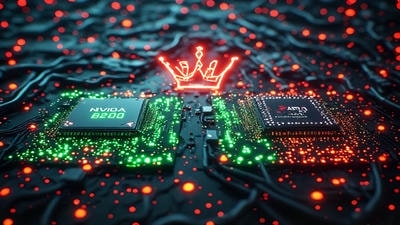
Nvidia B200 vs. AMD MI400: The 2026 AI Chip Crown Battle
By 2026, the race to power large‑scale artificial intelligence has crystallized into a few headline contests, and one of the most closely watched is the emerging battle between Nvidia’s B200 platform and AMD’s MI400 series. Both families target the same high‑stakes arena: training and inference for frontier‑scale models, hyperscale data centers, and enterprise AI deployments that push compute, memory, and networking to their limits.